The recent announcement from Transport Secretary Heidi Alexander has provided greater clarity on delivery timeframes and costs for HS2, giving renewed direction and momentum for the Skanska, Costain, STRABAG Joint Venture (SCS JV). Work to connect West Ruislip with central London continues to make strong progress, with Euston now firmly back in focus.
Preparing for the next phase in the London Tunnels programme of work
At Euston, teams are preparing for the arrival of the project’s final two tunnel boring machines (TBMs), Madeleine and Karen. Both machines were launched earlier this year from Old Oak Common – Madeleine in January and Karen in March – and are now making steady progress through London clay towards Euston.
Madeleine is currently travelling beneath Kensal Green Cemetery, while Karen is passing under the Grand Union Canal, with an expected arrival at Euston in 2027.
Beyond the tunnels, Euston has a wealth of heavy civils structures within the work scope for the station approaches, including complex bridge assets, box structures and open cuts within the design. Outside the site boundary, protection and monitoring of surrounding assets within the central London location also play a key role in enabling the job to be built.
As part of the HS2 reset, work on-site is centred around three key focus areas:
- Safety
- Improving productivity
- Cost-conscious mindset
Every step of work delivered by SCS JV and across the entire HS2 project from Euston to Curzon Street Station in Birmingham is firmly focused on working with these focus areas top-of-mind.
Investing in Skills and Opportunities
Work on HS2 isn’t just about building a railway, it’s also building a stronger legacy and skills pathway for future generations.
HS2 continues to create opportunities for people looking to start or develop their careers in the construction industry. SCS’s summer internships and graduate schemes are continuing to open doors for people, with many going on to secure full-time apprenticeships on the project. More than 1800 people have already joined the project, alongside a workforce of around 34,000 helping to deliver the new railway. As activity continues to ramp up at Euston; there will be further opportunities for those who want to be part of the project and build valuables skills for the future.
And SCS’s Skills, Education and Employment (SEE) team have just re-launched their summer school’s engagement programme across the project to inspire the next generation to consider a career in construction. The SEE team work closely with schools local to the SCS London Tunnels route and the programme is a key part of SCS’s commitment to the communities close to the project.
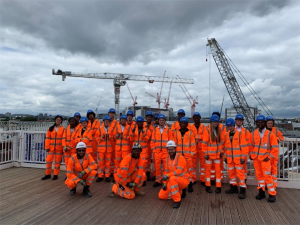
School students at one of SCS’s sites as part of the summer school engagement programme.
But their work doesn’t end there. SEE also invests in future talent by supporting new graduates, year-in-industry placements, and apprenticeships, with 22 new degree apprentices set to join the project in September. Their pre-employment programme plays a vital role in supporting unemployed people in the local community, working in partnership with the HS2 Jobs Board, the Recruitment Hub at Acton Job Centre, and supply chain partners to create opportunities for those who need them most.
Driving on-site innovation
Innovation remains a key focus, with new approaches being introduced to improve sustainability and reduce costs.
One example is through SCS’s commitment to the Decarbonising Concrete Programme, which has seen excavated London clay reused in a new way. Material taken from SCS sites has been processed into calcined clay and used as a substitute for cement as part of the construction of walkways in the tunnel. This is one of many examples where reused materials can deliver practical and environmental benefits to help inspire the future generation of railway projects in the UK and around the world.
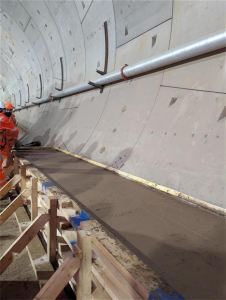
Calcined clay in a concrete pour
Supporting Local Communities
Work in the Euston area has not been without its challenges. Construction activity has had an impact on local businesses and residents, and this has been recognised by HS2 and SCS JV.
Stakeholder engagement efforts are ramping up, with a key focus on listening and responding to concerns and working with site teams to reduce disruption for local residents.
The future benefits of HS2 to the Euston are also worth talking about, with an estimated £41 billion boost to the local economy over the next thirty years and the introduction of 34,000 new jobs.
SCS’s Delivery Services Director, Nia Griffiths, and Section Engineer, Daisy Muge, will be speaking on a panel session at the forthcoming High-Speed Rail Group event, talking about the upcoming work at Euston and the legacy it will be leaving behind for future railway projects in the UK.