HS2 has reached a major milestone with the start of excavation for the final tunnel bore on the 140-mile railway between central London and the West Midlands. This marks a significant step forward in delivering better connected new rail infrastructure for the UK.
The last of 11 tunnel boring machines (TBMs) for the project — TBM Karen — has begun its drive from Old Oak Common station towards Euston station, completing the second bore of the 4.5-mile Euston Tunnel.
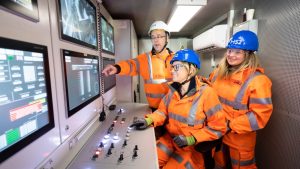
Named after Karen Harrison, one of the first female train drivers in the UK, the launch celebrated diversity in engineering and rail operations. Two female train drivers from Avanti West Coast joined engineers in driving the TBM, highlighting the essential skills and expertise behind the project.
The TBM is the final machine to be launched on HS2 to complete the bored tunnels on the HS2 route between the West Midlands and London. Four other tunnels have now been completely bored – the Northolt, Chiltern, Long Itchington Wood and Bromford tunnels.
Euston is the second bored tunnel underneath the capital – after the Northolt Tunnel – and is being constructed by HS2’s London tunnels contractor, Skanska Costain STRABAG joint venture.
The giant tunnelling machine was manufactured by the world’s leading TBM supplier, Herrenknecht AG, in Germany, before being shipped to the UK and reassembled in the underground station box at Old Oak Common.
The 198-metre long machine operates as a 24/7 underground factory, excavating the earth and installing concrete segments into rings to create the tunnel. Overall, on both bores of the tunnel, 48,294 concrete segments will be installed, and 1.5 million tonnes of spoil will be excavated. Each 6-tonne concrete segment has been manufactured by STRABAG in a newly-established facility in Hartlepool, UK, before being transported down to the capital by rail.
When complete, the Euston Tunnel will bring Britain’s high-speed trains directly into central London, increasing capacity, improving reliability, and supporting faster journeys across the network.
The government’s commitment to a new Euston station station is also a catalyst for wider regeneration, unlocking investment, new homes, and employment opportunities in the area.
For the High Speed Rail Group, this milestone underscores the capability and innovation of the UK high-speed rail supply chain and the importance of maintaining a steady pipeline of long-term infrastructure projects to support economic growth, skilled jobs, and regional connectivity.