Construction of HS2’s green tunnel at Wendover in Buckinghamshire has reached a significant milestone, with the two halves of the 1.4km cut-and-cover structure now joined.
The tunnel is being built within a cutting alongside the A413 to the west of Wendover. Once complete, earth will be reinstated above the structure and the surrounding landscape restored, helping to integrate the railway into the countryside while reducing noise and disturbance for local communities.
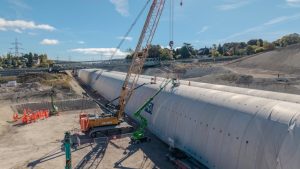 The final precast concrete segment of the central section was installed this week, joining two sections that have been constructed simultaneously to accelerate the programme. The construction team marked the occasion by signing the final segment before it was lifted into position.
The Wendover tunnel is being constructed in an ‘M’ shape, with separate structures carrying northbound and southbound HS2 services. It comprises approximately 2,740 precast concrete segments.
With the central section now complete, work is moving on to the portals at either end, the floor slab and the tunnel’s internal fit-out. Ellesborough Road, which currently crosses the construction site on a temporary bridge, will eventually be realigned over the top of the completed tunnel as part of the final landscaping works.
Engineering innovation and lessons from construction
More than 1.2 million cubic metres of material, predominantly chalk, has been excavated to create the level base for the tunnel. Much of this material has been retained on site and is being carefully backfilled and compacted above the structure, with the process designed to distribute the weight evenly.
The tunnel is being delivered by EKFB, the main works contractor for HS2’s central section through Buckinghamshire and into South Warwickshire. The joint venture comprises Eiffage, Kier, Ferrovial Construction and BAM Nuttall.
Wendover is one of three green tunnels being delivered by EKFB, allowing construction teams to share lessons and refine techniques across the different sites.
Measures being introduced include prefabricating reinforcement cages for the base slab, improving concrete deliveries through the tunnels and testing larger machinery for backfilling operations.
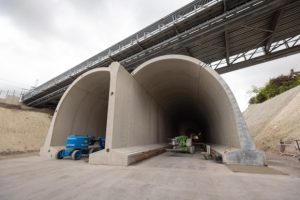
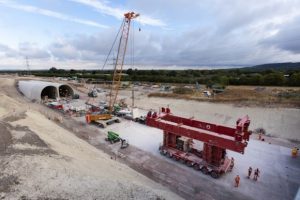
The project has also required specialist lifting techniques. While most of the precast segments were installed using cranes, those beneath the temporary Ellesborough Road bridge were positioned using a self-propelled modular transporter (SPMT). Supported by 16 sets of wheels, the highly manoeuvrable machine enabled engineers to lift and precisely position the segments from underneath the bridge.
Part of a major tunnelling programme
Wendover is one of five ‘green tunnels’ being constructed on the HS2 route between London and Birmingham. The Copthall tunnel in Hillingdon was completed earlier this year, while other cut-and-cover tunnels are being constructed at Chipping Warden, Greatworth and Burton Green.
Across the wider HS2 route between London and the West Midlands, around 105km of tunnels will ultimately be constructed, alongside the excavation of approximately 130 million tonnes of earth.
The majority of the tunnels will be deep-bored, but the shallower cut-and-cover structures provide an important means of reducing the railway’s visual and noise impact where it passes close to communities and sensitive landscapes.
The progress at Wendover demonstrates the scale of the engineering and earthworks involved in delivering the new railway, while also highlighting how construction techniques are being refined as work progresses across the route.