Another significant milestone on the HS2 project has been reached with the completion of Curzon 2 – a landmark bridge which forms part of the Curzon approaches into Birmingham Curzon Street Station. The bridge is now undergoing final preparations ahead of a complex launch operation over the existing Cross City railway line just outside Birmingham city centre. Once fully installed, Curzon 2 will rise to more than 40 metres above ground level, making it one of the most visually striking pieces of infrastructure on the route and a prominent new addition to Birmingham’s skyline.
Curzon 2 forms part of a wider network of five interconnected viaducts that will carry high-speed services into the centre of Birmingham. Together, the structures represent the final mile of the railway approaching Curzon Street Station and are a major component of the extensive civil engineering programme now progressing across the West Midlands section of the route.
The bridge itself is a substantial feat of engineering. The 4,200-tonne structure features a distinctive 24-metre-high steel truss made up of 670 individual weathering steel sections, fabricated and welded into triangular units before assembly on site. The use of weathering steel means the structure will naturally darken over time, helping it develop a distinctive appearance designed to reflect Birmingham’s industrial heritage.
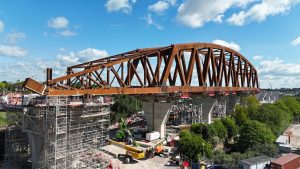
A team of approximately 250 engineers working for HS2 Ltd’s construction partner Balfour Beatty VINCI has spent the last three years delivering the superstructure. Construction first began in 2023 with the installation of 32 permanent piles, each extending around 30 metres into the ground to strengthen the foundations for the viaduct. During 2024, the project team assembled the bridge deck across the piers of the adjacent Curzon 1 viaduct, using cranes to lift more than 500 individual components into place before work began on assembling the enormous steel truss.
The location of the structure has added considerable complexity to the build. The site is tightly constrained between the River Rea and the operational rail network, requiring extensive coordination and highly controlled construction methods. Cranes weighing up to 650 tonnes were used to lift steel sections into position, while specialist welding teams worked day and night at height within protective fabricated enclosures designed to shield operations from high winds and adverse weather conditions.
With the structure now complete, the entire bridge deck and truss will be moved 180 metres into its final position using a high-precision hydraulic jacking system in a carefully controlled three-phase launch operation.
The first phase will involve pushing the structure 50 metres to the boundary of the operational railway line during overnight working to minimise disruption to passenger services. The second phase will require a temporary closure of the Cross City line between Birmingham New Street and Lichfield Trent Valley from Friday 29 May to Sunday 31 May 2026 while the bridge is pushed 93 metres over the twin railway tracks. The final phase will involve a further 37-metre movement to securely lock the structure into place on four permanent concrete piers positioned either side of the railway.
Balfour Beatty VINCI has worked closely with Network Rail and West Midlands Trains throughout the planning process to coordinate the operation and minimise impacts on rail users.
The completion of Curzon 2 also highlights the wider progress being made across the Curzon approaches programme. Earlier this month, the first stage of the six-phase launch operation for the Duddeston Junction viaduct was successfully completed. At Lawley Middleway, the first launch phase was completed in 2025, with further sections currently being assembled and welded in situ. Meanwhile, works are continuing on Curzon 1 and Curzon 3, which will ultimately connect directly into the platforms at Curzon Street Station.
Beyond its engineering significance, the project demonstrates the scale of skills, industrial capability and supply chain expertise being supported through long-term rail infrastructure investment. The works have involved civil engineers, steel fabricators, crane operators, welders, logistics specialists and apprentices, reflecting the broad range of capabilities required to deliver major nationally significant infrastructure projects.
As visible progress continues across the West Midlands route, structures such as Curzon 2 are helping define the future railway while also acting as symbols of wider investment, regeneration and economic transformation linked to better connected new rail infrastructure.